
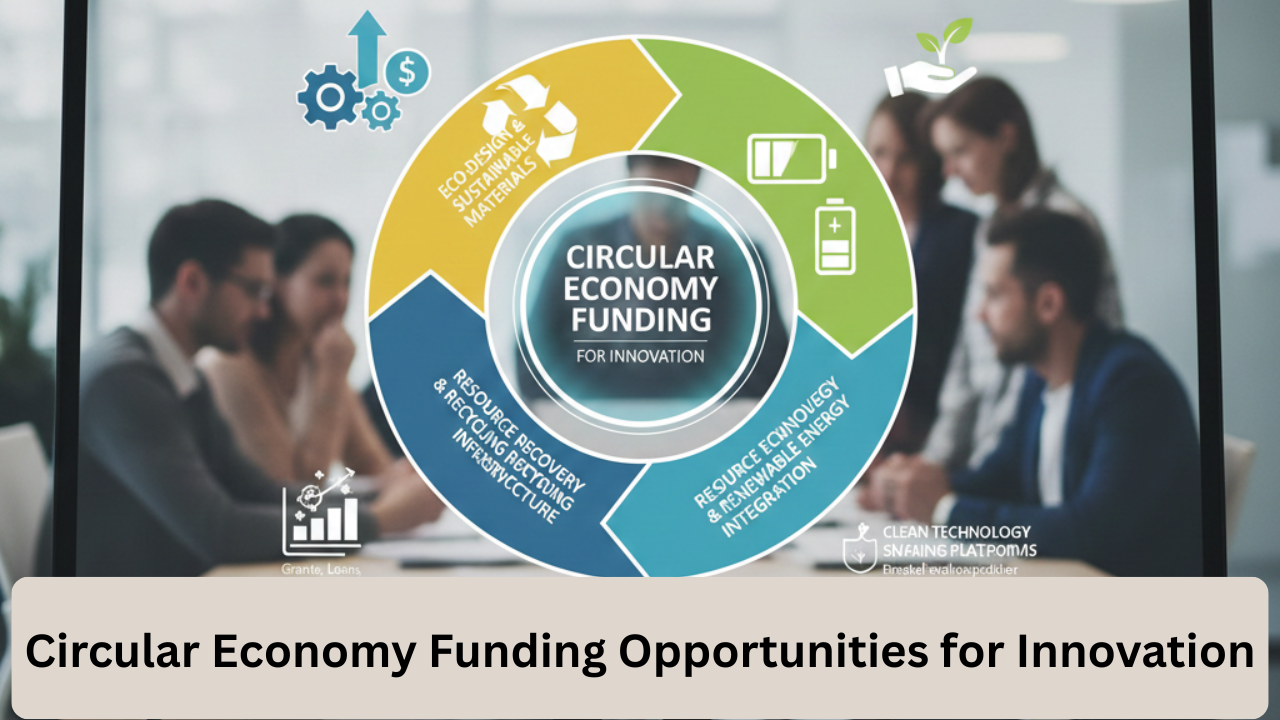
The concept of a circular economy has emerged due to the reason that the resources are increasingly becoming scarcer, climate change increasingly becoming more pressing, and the nature of how we create and consume things is shifting. Circular economy transforms the previous approach toward focusing on the old take-make-waste model and prioritizes reuse, repair, remanufacture, and recycling to reuse a discarded object and transform it into a useful one.
The innovation, entrepreneurs, and businesses have much more avenues available to them to access money to create, use, and expand circular solutions due to this change. The paper discusses major forms of funding, types of projects that can funded, and provides helpful hints on how to get started.
Why make the circular economy and some new ideas go together?
New materials, new business models, online tracking systems, and a total redesign of supply chains are all forms of innovation that are relevant in making a circular economy successful. The better news is that many funding programs are sufficiently aware of this and are actively seeking out circular economy technologies.
- In one example, the European Commission through Horizon Europe program has allocated more than EUR120 million to research and innovation projects on the circular economy on Cluster 6. These were textile chains, furniture, electronics and regional circular solutions applications.
- Circular Bio-based Europe Joint Undertaking (CBE JU) has declared over EUR200 million funding calls in bio-based circular economy technologies. These consist of the expansion of biorefineries, recycling wastes, production of bio-based polymers, and so forth.
- Small and medium-sized business (SMEs), supply chain actors and new business models also called upon. As an example, the UP2CIRC open call to SMEs in the textile and a circular business practice.
- These money-sourcing options have a larger change: circular means are not only important to a select group of individuals; they now have competitiveness influence, climate policy and innovation in industries. The key aspect that innovators need to establish is to determine how they can align their project with other sources of funds and how to ensure that it can make a difference and expand. Various sources of funds and their location.
Different kinds of funding and where to find them
Here are some of the main types of funding you should look into:
- Research and development and prototyping.
These subsidies facilitate initial innovation, such as new materials, processes, business models, pilot demonstrations and feasibility studies. As an example, the CBE JU funding include those that investigate new technologies, Research and Innovation Actions (RIAs), and those that assist prototypes prepare to enter the market, Innovation Actions (IAs).
- Small and medium-sized business money and technology assistance.
Grant programs assisting small businesses in adopting the circular practices or establish circular business models usually are beneficial to small businesses. As an illustration, the UP2CIRC open call assists companies with a small and medium size and working in the textile sector shift to more circular economy operations.
transition-pathways.europa.eu Such programs may not only be providing money, but may also be providing mentoring, technical assistance, and networking.
- Large-scale investment and implementation.
Scaling up and implementation of a technology or business can funded once it proven: e.g. CBE JU main innovation activities to develop the first industrial biorefineries of its kind. These require additional finances, company clusters, inter-industry inter-company relations and business strategies.
- Investment in novel business models and services.
Most funds are aware that the circular economy requires not only new materials and technology but new forms of conducting business, such as product-as-service, sharing platforms, and reverse logistics. New ideas may also sought by funds these models. One example is the previous demands of the European Institute of Innovation and Technology (EIT) of a digital product passport and circular business models.
What kinds of projects can apply?
The general eligibility and selection criteria include the following:
- Circularity and resource efficiency: The projects are supposed to demonstrate how they use fewer resources, help products to last longer, recover materials or otherwise pursue the goals of a circular economy.
- Innovation: This is extremely essential to R&D funds. Being improved is not enough, you have to demonstrate that the solution new or fresh its context or application.
- Scalability and market potential: This is because many programs desire solutions to be able to move to pilot to large scale commercial implementation. Collaboration and consortium: In large awards, business-business collaboration, university-business collaboration, small and medium-sized business -collaboration, and even collaboration between countries (such as EU programs) required.
- A business model or value chain: Investors need to understand how the new idea would make money, generate employment, and assist in objectives towards competitiveness or sustainability. In Europe, to ensure that your proposal resonates with one or more policy priorities within the big five (the circular economy action plan, the bio-economy or Zero Waste) may give it more strength.
- Concrete impact: A lot of calls seek to have concrete social, economic or environmental outcomes, such as the diversion of tons of waste, the development of new markets, or the elimination of emissions.
Conclusion
Circular economy is a way of transforming the way we do things in order to be able to continue to grow in a manner that is environmentally friendly, utilizing resources in a more efficient manner and remain competitive in the long term. With the world economy increasingly being put under pressure to able to separate value creation and resource depletion, innovation has become the most valuable mechanism through which this change can occur.
Fortunately, now there increased access to accelerate access to more solutions on circles. They include state grants and research programs, as well as, private investment and small business support programs. These sources of funding provide the entrepreneur, the researcher and the business with even greater than money. They also provide them with access to alliances, technical expertise and international connections.
The successful ones will be those who demonstrate the compatibility of their new ideas with the principles of a circle, reducing wastage, increasing product life, and resource regeneration, and also demonstrate that they have a definite market potential and can bring positive change. Finally, the financing of the circular economy is not only about money, but also about altering the thinking approach towards design, production, and consumption.