
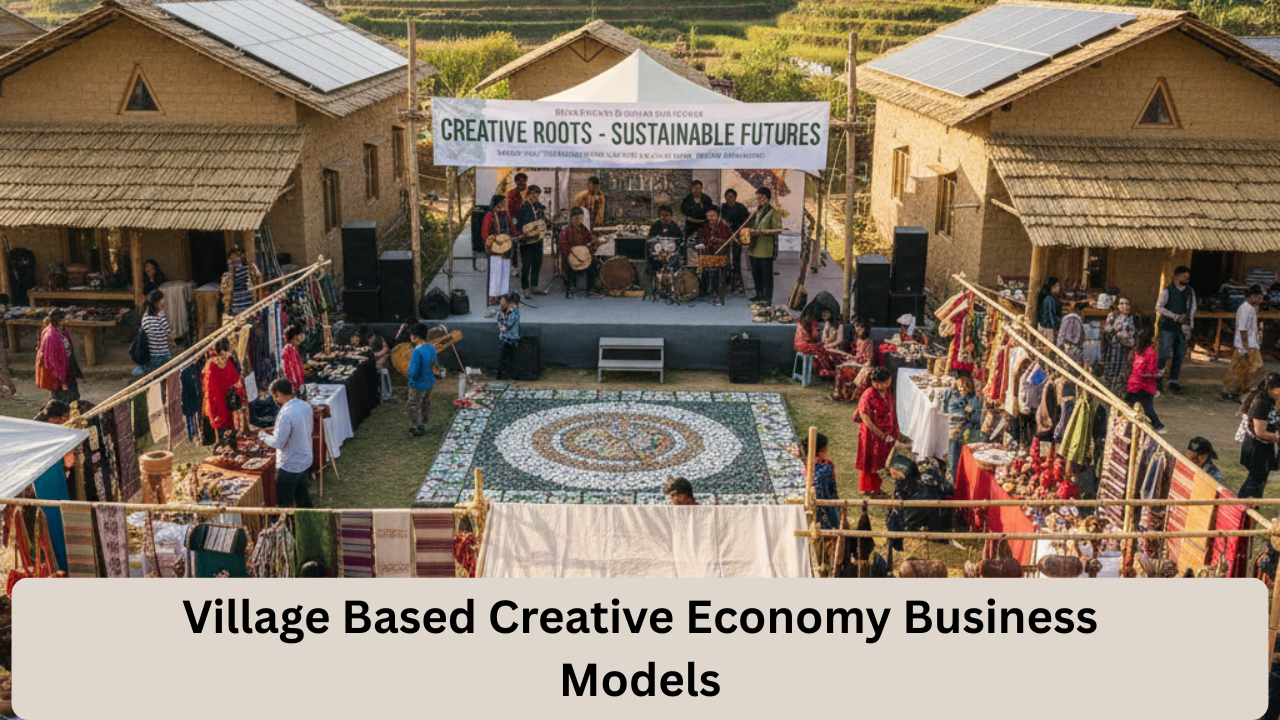
During the past years, communities in the rural areas all over the world have begun to visualize their economic future through creativity, culture, local resources, and digital tools. The shift of farming or mining as a means of livelihood to what we could term village-based business models of creative economy allows new opportunities of long-term growth, cultural revitalization and sustainable development.
In this posting, we examine the appearance of these models, the importance of each model, and how the best manner that villages can utilize them. The creative economy stresses on the application of imagination, innovation, and cultural heritage as the basis of value creation. This would not only diversify incomes in rural settings but also the identity of the local people and their ability to resist whenever there is a crisis.
The formerly reliant agricultural, mining, or traditional crafter villages have the ability to increase their economic potential with involved creative businesses adopting a blend of tradition and modern technology. Flexibility is one of the best benefits of the creative economy. The creative businesses do not need extensive capital to operate unlike the other large-scale industrial models as they can employ skills, stories, and resources already present in the community.
What is the purpose of villages having a creative economy?
The concept of the creative economy a broad term, which is defined as an economic activity associated with culture, creativity, ideas, and new ideas. Creative economy particularly promising to the villages as they often densely populated, possess local resources, traditional cultures, and often lack proper infrastructure.
Rather than merely depending on external capital, it allows you to exploit local expertise (crafts, traditions, food, and natural resources). As an example, a research in Gunungkidul Regency showed that a competitive advantage can be wood-mask batik crafts, which is based on the local culture. Untidar Journal It allows people living in the country to acquire money not only through agriculture and seasonal work.
It assists towns in achieving large value chain, new market (including via digital tools) and value addition. It promotes inclusive growth by involving women, the youth, artisans, persons with disabilities and people with social capital. In a study carried out at Dukuh Tengah Village (Sidoarjo, Indonesia), it was found that the inclusivity of the creative economy was achieved through strong social networks and values.
Village-based Creative Economy Important Business Models.
The following are some of the types of business models that the villages could adopt and usually adopt them to suit themselves.
- Resource based creative products.
This is a strategy which takes advantage of the natural or cultural resource of a village to craft a creative product or service. As an example, seaweed can used as snacks, jam, tempura, and other foodstuffs in the coastal areas. A study conducted in a tourism village revealed the level of women cooperation in creating some items using seaweed. As an illustration, ancient carpentry and shipbuilding techniques were applied in the Vietnam wood-working town of Kim Bong to produce artisan furniture and market places, which were sold to the tourists. - Local Culture + Tourism Experience Model: In the given model, the town relies on cultural resources such as crafts, performing arts, and food that can used to develop an experience and a product. The Kendran Village in Bali was a tourism village, which combined art carving, sculpture, and hacks with visitor trips and souvenir production. Regional Daily Journal The plan proposes that the government, business, and society collaborate in order to create a creative space to accommodate the visitors.
- E-commerce or online marketplace Cluster Type of Model.
In order to overcome the physical isolation caused by physical separation, communities can adopt new digital systems through e-commerce to access larger markets. The Taobao village in China is one of them. These are the rural villages where e-commerce made a significant portion of the economy, and there were many online shops and the yearly sales that exceeded a specific threshold. This model exerts much pressure on educating people on how to operate technology, logistics, package and market them. The villages turn out to be networks of small innovative enterprises, which driven by the internet.
Enablers Implementation: Steps.
A number of steps and factors are significant to implement a village-based creative economy business model.
- Recognize the village creative potential/resource.
Study what the village possesses in the nature, culture, craft, food, skills, traditions, and materials. As an example: local seaweed, traditional weaving, wood carving. - Develop capacity and human resource.
Design, production, quality control, digital marketing training. Indicatively, the use of inclusive education and digital technology assisted Yogyakarta villages in creating creative economy by relying on local wisdom. - Establish connection and alliances.
Cooperation between the village community, the government, the private sector, academia (the so-called penta-helix model) is frequent. The researchers highlight the importance of institutional empowerment + human resource capacity + stakeholder engagement in a case of a coastal village. - Establish branding, advertisement and market penetration.
By tourism, e-commerce, regional fairs or otherwise, the village has to make a presence and be available outside the local context. The 4P marketing strategy (product, price, place and promotion) that implemented in tourism villages is highlighted research. - Sustainability & innovation
The model has to change: it should incorporate new designs, technology, business practices as well as adapt to the changes. A study of potential of the creative economy in rural areas suggests that there are stages of development through which villages develop: initiative → productive → innovative → sustainable.
Conclusion
The business models of village-based creative economy are a powerful and opportune solution to rural locations to strategize on an environment-friendly, inclusive, and innovative economic future. The goal is to integrate local identity, human creativity and relationships between institutions and markets. It could be in the form of resource-based creative products, cultural model related to tourism, digital marketplace cluster, or village-owned model of companies.
Past issues, including infrastructure, coordination, and scaling, still need to be solved, although increasing amount of research, both Indonesia and elsewhere, proves that such a model can work. With as many villages as possible being creative economy thinkers, not only local prosperity, but national growth, resilience and cultural vitality added to the national community.
This transformation does not happen overnight—it begins with small, consistent steps toward collaboration and innovation. One can clearly see what every village leader or development worker must do: discover the village’s unique creative strengths, invest in people, build strong relationships, and share that story with the world. Through these efforts, creativity becomes not only a source of pride but also a sustainable pathway to economic empowerment.