
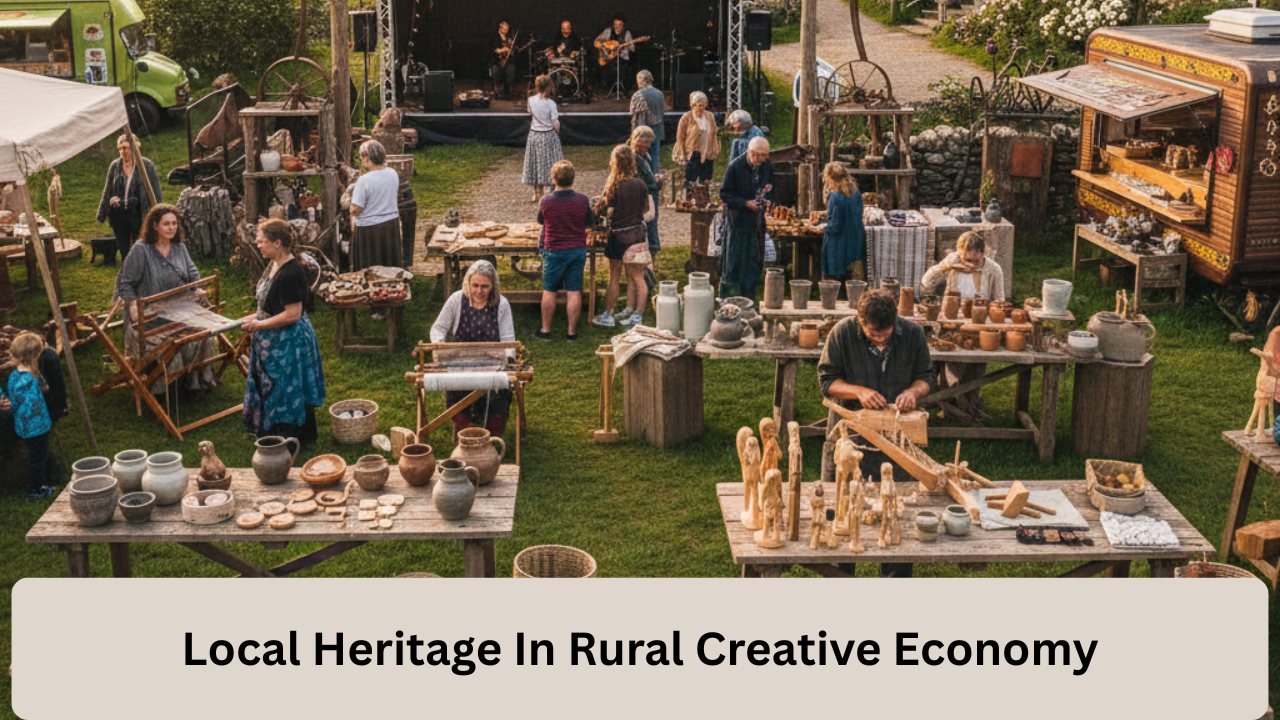
Local heritage (both tangible and intangible) has a long regarded quiet reminder of the past in most rural locations throughout the world. However, at a time when the economies re-evaluating their developmental patterns, this heritage increasingly being viewed as an active resource: a resource of imagination, innovation and community-based prosperity. Local heritage and creative economy may be beneficial to rural areas when merged.
This work discusses why it matters, how it functions, the challenges that it encounters, and the most effective methods of ensuring it does so. Creative economy is a term that used to describe the economic processes that make use of personal creativity, skills, and talents to create value including those the arts, craft, design, media, tourism, and culture.
The initiatives of the creative economy in the rural areas usually depend on local heritages as a foundation of inspiration and content. These initiatives granted identity as well as context through local heritage, whether material, such as historic buildings and landscapes, or intangible, such as oral traditions, folklore, and local knowledge Instead of viewing heritage as a dead asset of the past, rural populations can use it as a source of living by developing the rural economy.
Defining the Rural Creative Economy
The creative economy consists of the companies, which exploit imagination, skills, and talents of people to make a profit. These enterprises earn some cash in diverse spheres, including media, tourism, heritage, design and crafts, media and others. Study on Indonesia indicates that to the economy of the country, the activities of the creative economy have a considerable effect when supported by education, availability of the internet, and an enabling environment.
Heritage may be cultural (craft techniques, folkloric practices), intangible (oral history, local identity) or built (historic buildings, landscapes). It may serve both content and source of creative economy projects. Rural-wise, it implies that heritage not to perceived as a burden or a dead relic; rather, it supposed to be perceived as a living base.
This encompasses long-standing crafts, tales that hold the place together and sceneries that have fashioned by custom. They can result in new work, commodities, and experiences to visitors, domestic markets, and niches worldwide when they creatively interpreted.
The Importance of Local Heritage in Rural Creative Economies
The heritage-based creative economy strategies in the rural areas are attractive due to several reasons.
- An individual personality and a distinguishing factor. Infrastructure, size, and normal business are some of the areas where the rural regions find it difficult to compete with the cities. Nevertheless, they tend to possess their cultural identities and heritage goods. In the example of the rural village of Nglanggeran in Yogyakarta, the research concluded that the rural identity was beneficial to the economy and the sustainability of the region. The Gadjah Mada University Journal Business creative in the rural setting can be unique in the crowded markets by exploiting such peculiarities.
- Heritage as a means of creating something new. Research has indicated that a higher number of heritage items a place are bound to make it creative and possess a good economy. In one of the studies, it was established that a modest increase cultural heritage assets number was associated with an increase the GDP and increased trademarks, which indicators of business growth.
- Community and place based development. A traditional-based rural creative economy is more prone to have local artists, storytellers, and actors within the neighborhood, as opposed to larger external-based companies. Indicatively, an examination into the English rural creative micro-clusters found out that these groups rely on facilities based on heritage and culture besides a range of local businesses.
Strategies for Building a Successful Heritage-Based Creative Economy
Success strategies Building a rural creative economy based on heritage.
- Based on the study that is coming out in both world wide and local contexts, there are a few strategic themes that are emerging that would make the likelihood of success a possibility.
- Participatory approach and place-based approach. Making sure that heritage projects community-based, not foreign. There has to be involvement of communities in design, decision-making and benefits sharing. UNESCO focuses on the significance of the framework of people, places, and policies.
- Innovating on the basis of heritage. Rather than simply copying traditions, creative businesses have an opportunity to re-invent heritage differently- new designs, new formats, new media, new markets. According to Strategic Design Research Journal, design contributes to creating cultural value which improves competitiveness.
- Attaching heritage to value chains and creative industries. In addition to the craft or tourism, the creation of networks to design, digital platforms, global markets, branding, and collaborations. To develop rural clusters, it is important to have a linkage in terms of value chain.
Infrastructure development and capacity building. Skills training (particularly among the youth and women), internet connectivity, marketing medium, logistics and enabling policies. The creative concentration of workforce and the factors in support of it are important as illustrated in the Indonesian work.
Sustainability and conformity to local system. Creative economy is based on heritage and should be economically viable, culturally respectful and environmentally sustainable. The high dependency on a market (e.g., tourists) may be dangerous.
Monitoring and adapting. Always checking what works, what does not work and being flexible to evolving market or environmental conditions. Studies point to the fact that the mere presence of heritage assets is not sufficient, but activation and involvement is.
Conclusion
Local heritage is much more than a thing of the past, it a living source of power, which can used strongly to influence the future of rural communities. The integration of heritage into the creative economy would help rural regions turn traditional knowledge, crafts, and cultural practices into sources of innovation, jobs and growth, which are sustainable. This does not only add to local identity but also assists in diversifying the sources of income besides boosting community pride.
Nevertheless, even appreciation of heritage is not enough to be successful. It relies on tactical planning, neighborhood engagement, capacity building, and infrastructural facilities which assist in creative business. There should be policies that safeguard authenticity though promote adaptation and innovation. It is important to work together between the government, community, academia, and the private sector to enable toddlers to share the benefits in an equitable manner and to turn heritage into the source of empowerment and not exploitation.
Finally, a local-driven creative economy based on local traditions establishes a state of balance between conservatism and development. It preserves culture, draws creative ability, and encourages place-based and inclusive growth. Through appreciation of the local and traditional coupled with incorporation of creativity and tools of modernity, rural population can have strong economies that acknowledge the history and preserve their future.