
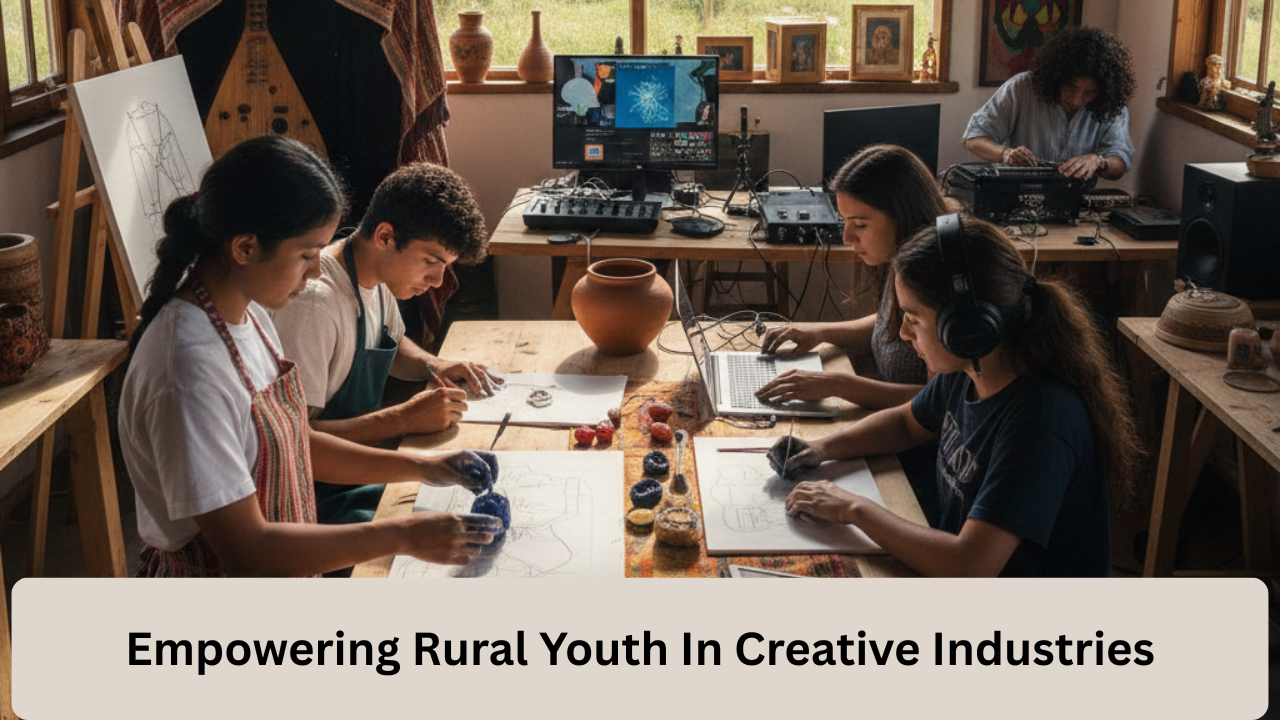
We usually come to think of cities when we have in mind creation as a whole. What do we picture? A downtown loft designer, a downtown filmmaker in a downtown workshop, a downtown musician in a downtown club. Yet, with a little care, we may catch some other, even more subdued symphony, the sound of leaves, of a loom, of youth in country districts, of which talents are the unexploited heartbeat of our own cultural future.
The creative industries, comprising of artisan, music, film, and digital media and design industries, are of the utmost importance to the development of the economy as well as culture. However, it has been far too long that we have not listened to their actual origin: land. Providing more opportunities to rural children in these regions is not merely a nice idea; it is the necessity in case we need to diversify our economy, save our culture, and make the world of creation a better place to all people.
The rural youth advantage boasts of authenticity.
Youths in the nation are not tabula rasa awaiting the city to impart ideas in them. Only they are able to preserve such rich heritage of culture. Their point of view is unique and very important due to the fact that they were brought up the environment of traditional crafts, local legends and identification with the land.
A child in a village may aware of the history that being sung in a folk tune, the pattern of the craft that narrates a tale or the annual ritual that attached to a recipe. Not only that it is a nostalgic feeling, but it is also a unique means of being ahead of the competition.
When in a world market where there have been mass-produced goods of the same, individuals keen to discover authenticity and tales. That pottery wrought with a hammer, that cloth stained with the plants of the neighborhood, that song that recounts a story of antiquity, all have a soul which can never produced in a machismo. It is not about the shortage of talent but rather it is a collection of structural obstacles which prevent using this promise.
The Great Divide: Separating Potential by Walls.
We can take the example of a young artist, Lakshmi who produces beautiful cloths, which are handmade. Her beautiful work purchased by the people of her village and the neighboring town. She is unable to travel to another country where the high-end store is located and would pay her a lot of money to buy the art. Or consider Kofi, a youthful man as aspiring to be a filmmaker. His filming videos of village life on his smartphone are intriguing but he lacks the editing programs, training and network to turn his passion into a profession.
It is what the truth of millions of people is. The obstacles are real:
- The Exposure Gap: It the inability to reach galleries, business events, and individuals who may be interested doing business with you.
- The Education Gap: It is the lack of specialized training by people in both creative techniques and business skills necessary to perform well.
- The Technology Gap: The internet is not always available, the software is too costly, and there is no sufficient good technology.
- Unless we construct a bridge between these two aspects, then creativity and a section of our common cultural heritage may lost out of the window.
Connecting Rural Creatives to Markets
What are we going to do to construct that bridge? It requires a complex approach that encompasses much more than conducting a single workshop. First, we should consider a new way of teaching. The skill should not taught and left at that. We must educate in artistic and business talent in the country schools. This involves acquiring such skills as graphic design, audio production, and digital storytelling, as well as such fundamental business skills as.
How to write a company plan, brand your work, money handling, and intellectual property knowledge. Young artisans must taught to view themselves as not only artists. They should believe that they are a CEO of their own creative company. Second, we must employ technology to bring about fairness. Creation is now accessible by everyone due to the digital revolution. The facebook page can become an international gallery and a cell phone can be a cinema.
The rural digital hubs (public space with stable Wi-Fi connections, computers, and software) can also be a source of creativity lives. Training vans can move to different villages and educate the youth on utilizing e-commerce platforms, how to create an online portfolio, and use Instagram or Etsy to market their creations. It is not about turning them into company marketers, giving them the reign of the world market.
Conclusion
It is a promise that must be opened by each of us as a team. The governments can contribute by involving creative businesses in rural development schemes, investing in the broadband infrastructure, providing microloans and grants to creative startups. Non-governmental organization (NGOs) and schools may contribute by providing people with the training, support and secure locations, so that they may become creative.
The private sector has the ability of being more than a customer by establishing equal and truthful supply channels of the creative products produced in the rural regions. Ultimately, this is concerning seeing things differently. Rural children are not an issue that has to be remedied; they are the solution that we have been lacking. It is them, who can know how to use both new and old tools in combination.
When we invest in their skills, we are not only providing them with an opportunity, we are also making sure that our own culture is rich, diverse and alive. he creativity will not just come into existence in forthcoming cool neighborhoods of the city. Young people are willing to demonstrate what they can do and it is in the towns, the fields and in their hands and minds. It is only our responsibility to ensure that we are all ready to listen.