
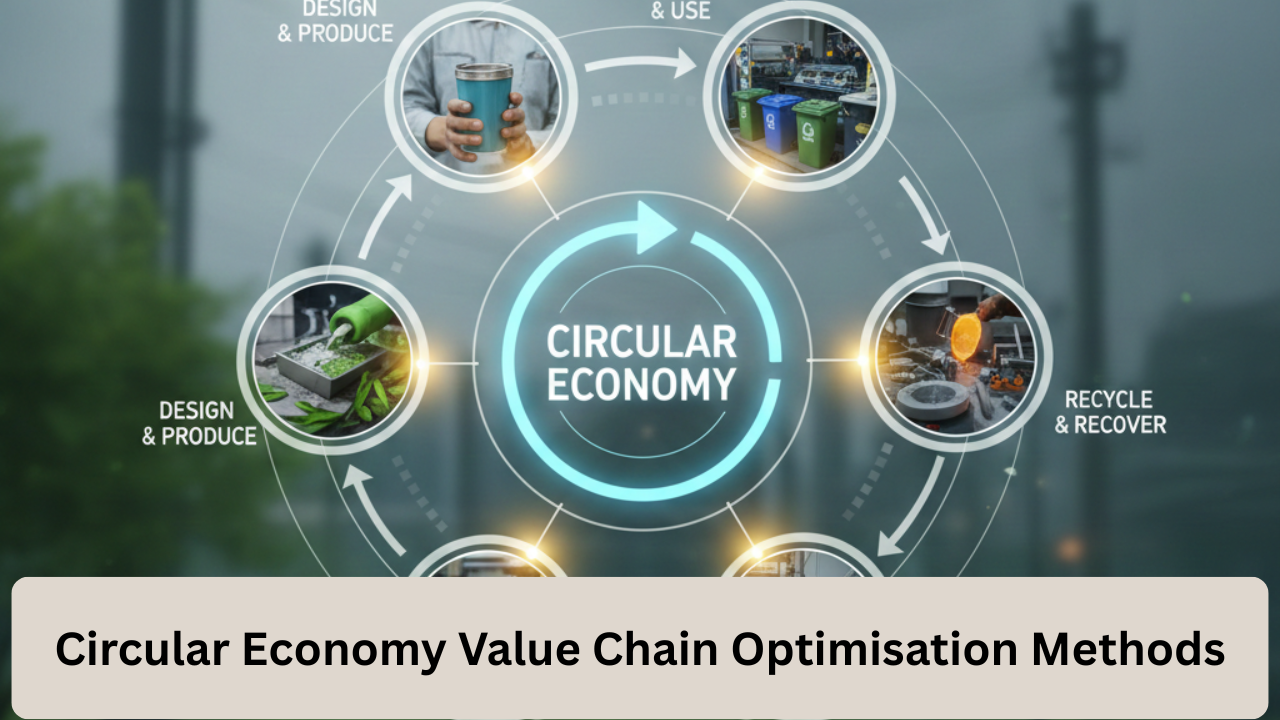
Numerous industries have come to understand over the last few years that the traditional model of take-make-dispose no longer works since resources are scarce, garbage is increasing, and consumers, as well as the government, are mounting increasingly high expectations on businesses to be more sustainable.
Another method to do things is the Circular Economy (CE): maintain as long as possible the resources in use, make the best out of them when in use and then recycle and regenerate goods and materials when one no longer needs them. The businesses must optimize.
Their value chain by transforming the manner in which they source, produce, transport, consume, and dispose of products. This article discusses the most significant methods of enhancing value chains in a circular economy environment with references to real-life examples, challenges, and resolutions.
Understanding Value Chain in Circular Framework.
The value chain in a circular economy must not only cover the upstream and downstream flows in the usual supply chain. It must have reverse flows (returns, remanufacturing, recycling), product life-cycle extension, and looping of materials. According to one study, value chain optimization of the circular economy does not simply want to maximize its earnings but also its value, which is the ability to make things cheaper, with reduced negative effects on the environment, and develop alternative sources of revenue and improve relationships with customers.
In the given case, the value optimization is the primary concept:
- The discarded things in the course of production or post-use may utilized in making new products and uses. Having the products used over an extended period of time or more than once may increase their value.
- The gathered research around the world shows that circuital-based optimization of the value chain enables organizations to reduce the use of resources by 20-30 percent compared with the traditional methods.
- The initial process of optimization, therefore, is to transform the value chain through forward and backward flow mapping, product lifespan, product design, reusing material disposal, digital tracking, and ensuring the business model aligns with the transformations.
Key Optimization Methods
Businesses could enhance their value chains in the circular economy in the following simple ways.
Eco-design and product life extension.
It is possible to achieve this in one of the most crucial ways available, by making goods that last longer and can more easily repaired, refurbished, and remanufactured. One of the most appropriate circular economy strategies is product life extension, as per the evaluation of the strategy.
Companies can also reduce waste as well as earn profits by producing products that are durable, repairable, and recyclable. That may be in the form of modular construction, selection of materials that can reused or recycled, designing to disassembled, creating components that can repurposed, or even allowing the customer to able to upgrade and not necessarily purchase a new one.
Looping materials Incorporating reverse logistics and remanufacturing.
The reverse side of the value chain is quite important to enhance. This involves establishing a logistic system for the return of end-of-life (EoL) products, sorting, refurbishing/remanufacturing, and reintroducing materials into the production system. As an example, one of the studies provides an input-circulation-output model.
Resource input—circulation—waste/output and employs a resource circulation efficiency equation to determine the points of value loss and potential ways to recover further. MDPI: The value that is built into the materials and parts can retained by the companies as closed-loop or nearly closed-loop systems developed.
Digitalization and the possibility to observe the value transfer.
The ability to see the entire value chain is what required to optimize. Such digital technologies as digital twins, IoT sensors, blockchain, and data analytics can ensure the monitoring of resources and goods, the measurement of the indicators of circularity, and the organization of actions in various situations. As an example, virtual-twin technologies enable companies to explore multiple sourcing solutions, considering costs and sustainability (e.g., whether a local recycled supplier or a virgin supplier located miles away is better) and identify the least favorable trade-offs.
Implementation and Performance Metrics Framework.
An organized approach to circular optimization normally has six steps:
- Mapping Baseline: Identify all the stages within the value chain, including the movement of materials, energy, and waste.
- Diagnosis and Metrics: Determine the productivity of your resources, the amount of value they contribute, and their environmental friendliness (e.g., the amount of waste or emissions produced per unit output).
- Scenario Modeling: Experiment with various circular strategies and sourcing decisions with the help of computer simulations.
- Redesign and Integration: Reorganize the way of doing things and how businesses operate to incorporate remanufacturing, leasing, and reverse logistics.
- Pilot Implementation: Process new systems on a small scale and then analyze the outcomes in terms of cost, material consumption, and emissions.
- Continuous Improvement: Spread sustainable-lean monitoring across to keep getting things improved.
Conclusion
The shift towards the circular value chains is a significant shift in the manner in which companies create, deliver, and retain value. The strategic change of being more environmentally friendly is not just an option of optimizing value chains towards the circular economy but rather a combination of economic efficiency and environmental responsibility. Eco-design, reverse logistics, digitalization, sustainable lean integration, business model innovation, and material substitution.
Companies need to make the most of their resources, reduce wastage, and extend the life of their products and materials. To get optimization to work, you must adopt a systemic and data-driven approach to combine process efficiency with new business models that place keeping value first before consuming resources. The digital technologies such as the Internet of Things (IoT), artificial intelligence (AI), and digital twins have a lot of importance in providing us with the information and analysis.
We require it in order to manage the circular flows well. The other organizational enablers, including leadership commitment, collaboration with other sectors and enabling policy frameworks to promote circular practices, are also important. Simply put, optimization of the circular value chain transforms waste into value, costs into opportunity, and linearity into strength.