
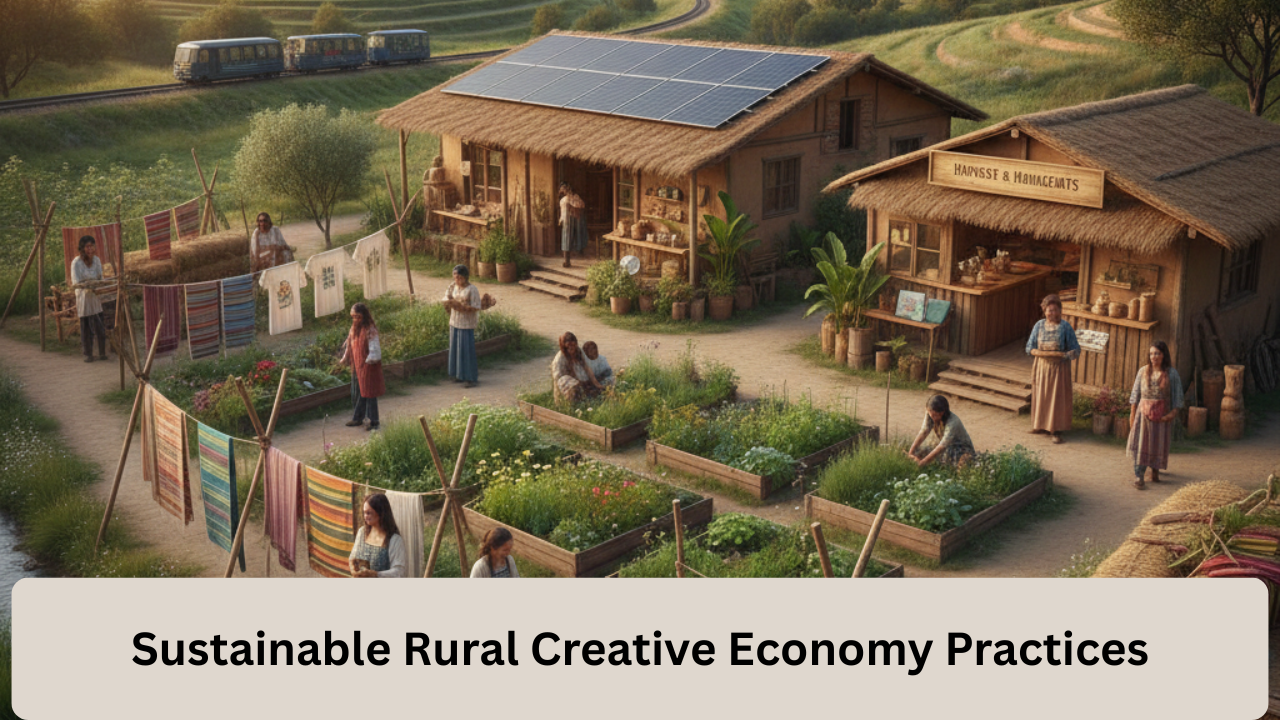
You may imagine a village where the monotonous rhythm of local creation beats the rhythm of life rather than the faraway murmur of world markets. Flutter of a loom is as usual as the clatter of a tractor, and the most precious commodities are not commodities in large quantities, but narratives, beauty, and personal experiences.
It is not a dream of the past but it is increasingly becoming a reality in the world, where rural regions are turning to the sustainable creative economy as an effective new development strategy. Such a change of doing things is immense. Over the years, the economy of rural areas was constrained and, most cases, depended on one sector, such as farming, mining, or forestry. This made them susceptible to alterations in the market and environmental strain.
A new narrative is being worked out that consumes the least amount of resources, the human resources, its culture, and its knowledge of a community. Through these strong points and a strong commitment to being a sustainable place, the rural places are not merely surviving; they are creating a future that is culturally diverse, economically powerful, and ecologically healthy.
Eco-Friendly Production and Resource Management
The premise of this plan is quite simple yet radical: the best things of a community are usually there already, and they are a part of everyday life. The elder knows how to create a pattern that narrates a story that is hundreds of years old. It is the secret of a certain mix, which has been lingering through families for a long time. The unique place is people and their stories and songs.
The sustainable practices bring out this information. Rather than making souvenirs in bulk, suppose craftspeople made them out of natural substances found near their houses, such as clay found on a local bank of a river or plants found in local fields used as dyes. But being green is not enough; we are going to make a product with a heart.
When one purchases a hand-woven basket, he/she is not only acquiring the object but also the part of the history and connection to a place and its inhabitants. This authenticity is a currency of considerable strength in a world weary of the same old things. It further ensures that the economic gains directly reach those who understand what it is like to do things and this raises a lot of local pride.
Community-Based Tourism and Experiential Economy
Sustainability in this instance is more than a business word; it is an elementary principle of survival. The problem of the natural environment is significant to creative activities such as food processing and pottery. The environment is regarded as an ally, a vibrant creative economy, rather than a cupboard to plundered.
It looks like:
- A natural dyer that cultivates her own plants rather than overpicking the number of wild species, which preserves the diversity of the region.
- A community of woodworkers who collaborate to ensure the forest remains healthy enough to support the future generation by ensuring that they use downed or harvested wood.
- A cheese producer taking solar panels to energize her tiny dairy and water recycling equipment as well.
In doing this, we will be able to create a closed-loop system in which economic activity contributes to the well-being of the environment. This will make us more resistant to environmental destruction as well as global supply chain instability. The local environment ceases to be a background and it becomes a significant aspect of the business, which should safeguarded.
Digital Platforms and Expanding Market Access
In the case of small towns, there might be good tourism as well as bad tourism. The past mode of operation usually causes excessive population, environmental degradation, and profits that end up in large corporations that are not in the community. This changed by tourism that assists the community in forming part of the healthy creative economy.
There is no necessity to construct large resorts. It is all about providing people with real and personal experiences. Think about a visitor being taught how to make pottery by a skilled artisan, having a meal prepared using the produce of a family garden, or taking a guided tour of the history of the landscape of the region described. Community involved in bringing these events to pass.
Many good things come from it. It is not only the sale of goods that provides the income. By taking their tourist gifts, they are not just purchasing goods but they become attached fans of the culture who share and value it. Above all, the community remains at the top of things and ensures that tourism does not alter their lifestyle.
Conclusion
Rural creative economy practices are sustainable and provide an opportunity to develop communities without exploiting their natural resources and cultural heritage. Rural regions can develop resilient and inclusive economies through tapping into local experience, embracing environmental friendliness in production, adopting community-based tourism, using digital platforms, and building networks of collaboration.
This issue needs to supported by the policies and sustainability needed for this effort so that creation not only beneficial to people but also to the environment. Finally, once the rural communities adopt these practices, their livelihoods will not only improve, but it will also bring about a more balanced, culturally diverse, and sustainable future.