
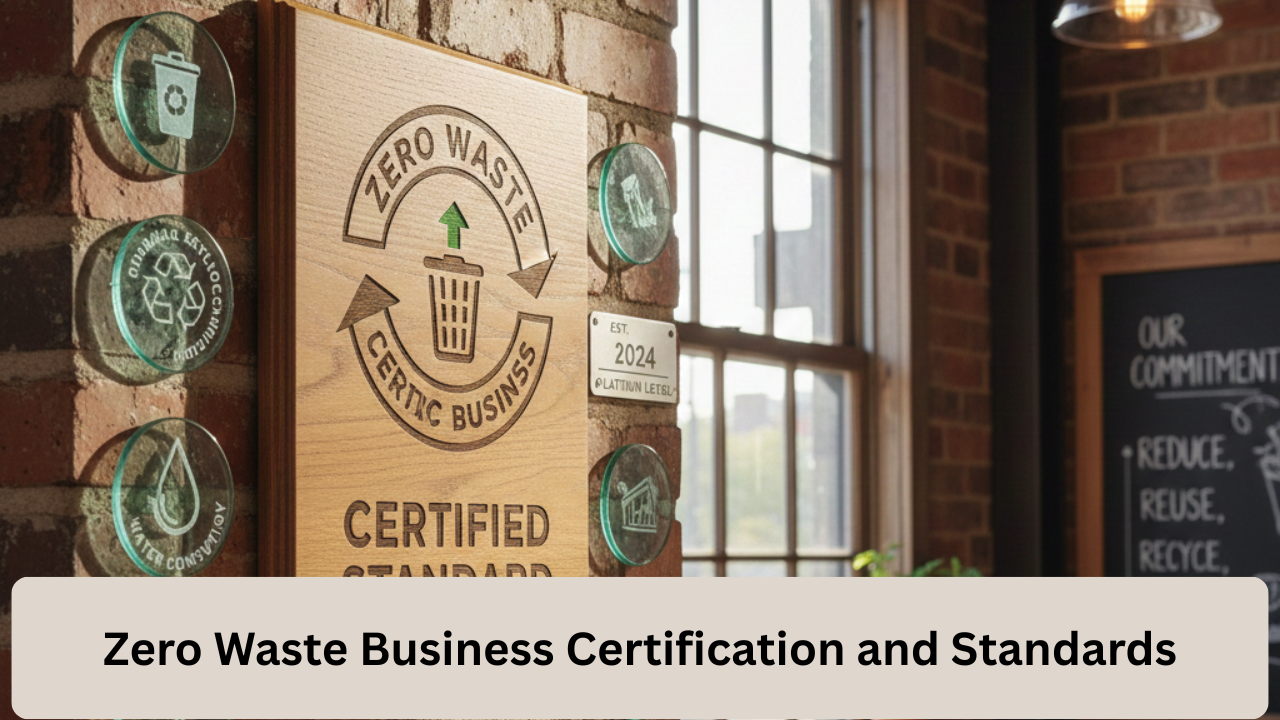
With the current economy that is geared towards sustainability, businesses likely to have lesser effects on the environment. This does not only imply reduction of emissions and energy conservation, but also handling and ultimately disposing waste. The concept of zero waste certification of businesses has turned out to be a major instrument.
It is an official indication that a business is in the process of decreasing and diverting waste, shutting loops of resources, and assisting in the establishment of a circle economy. However, what is this certification and what criteria used and why does it matter? The article discusses the concept, the key standards, the advantages and disadvantages as well as how businesses may set out to be certified.
What is Zero Waste as far as business is concerned?
Zero waste in a company context implies attempting to dispatch no garbage to either the landfill, incineration (without energy recovery), or the environmental area. It is an alternative to the take-make-dispose economy of the past where things reused, recycled, compost or otherwise kept a productive use. A famous definition is that of the Zero Waste International Alliance (ZWIA):
The conservation of the entire resources by way of responsible production, consumption, reuse and recovery of product, packaging and materials, without incineration or any discharge to environment, land, water or atmosphere that may threaten environment or human health. In a business context, this means to ensure that waste prevention, reuse, high quality.
Recycling, designing of the product to be repaired/disassembled, supplier responsibility and the clear reporting all involved the process. The principles of Zero Waste Business proposed by ZWIA emphasize that it is important to make big promises in every aspect of business, both in the operations and supply chain department as well as in the product life cycle.
Alliance to Zero Waste International.
The significance of the Zero Waste Certification.
So why should a company seek formal evidence that it is operating towards being zero waste? There are many good reasons:
- Credibility and transparency: Certification has third-party validation, which helps prevent greenwashing and demonstrate that you so interested in your stakeholders (customers, investors, regulators) that you do care about them.
- Competitive differentiation: The certification may enhance the reputation of the company, get attracted by customer who cares the environment, and enhance the sustainability credential.
- Operational savings and efficiency: Companies can tend to conserve cash in the area of garbage and formulate fresh methods of utilizing resources more effectively by concentrating on preventing squandering, reorganizing material processes as well as enhancing reuse and recycling.
- Regulatory conformity and mitigation of risk: With the waste regulations becoming more stringent across the globe, being a leader is a reduction of the risk of not being a follower. Certification will demonstrate that a company is making a move.
- Serving world objectives: Zero-waste policies would be part of larger sustainability strategies, such as circular economy and UN Sustainable Development Goals. As an example, the ZWMS International Standard (Zero Waste Management System) aligns with the SDG goals related to responsible consumerism, living on land, and taking action on climate change.
Widespread Certification Specifications.
Although each of the programs may have its own comprehensive checklist and review procedure, there is little that will be uniform throughout:
- Waste diversion target: This is one of the key indicators of numerous certifications which the percentage of waste that not deposited in landfills and incinerators. An example of this TRUE which must have not less than 90 percent, and SCS programs which allow certification provided that at least 50 percent of waste diverted.
- Policy, planning, and governance: Companies need to have a formal “zero waste” policy (also called “Resource Use Efficiency”), a strategic plan with goals, deadlines, roles, and duties, and it needs to be part of corporate governance.
- Measurements and tracking: baseline waste audits, keeping track of how materials move up and down the supply chain, keeping track of reuse, recycling, and composting, and measuring how much trash thrown away.
- Changes to infrastructure and operations include setting up separate collections, reuse systems, redesigning to cut down on packaging, getting rid of single-use goods, improving material flows, and better managing contaminants.
- Some standards say that you should think about material flows both upstream (suppliers) and downstream (the end of the product’s life). For instance, Mission Zero’s standards involve looking at waste in both the supply chain and the value chain.
- Culture, training, and communication: Training employees, getting them involved, reporting on the zero-waste approach, and talking about it with those outside the company.
Benefits of Achieving Zero Waste Certification
Getting certified for zero waste has real benefits:
- Cost savings: less trash to throw away, better use of resources, and perhaps new sources of income from reusing things.
- Brand and marketing advantages: being unique in an environmentally friendly market, providing a customer, investor or partner with better credentials.
- Increased sustainability performance: Diverting in a better way positively impacts the ESG (environmental, social, and governance) metrics. The SCS standard emphasizes openness in the waste diversion in the ESG reporting.
Standards for SCS - Risk mitigation refers to taking care of the risks to your reputation and the law that there exists in using trash and resources.
- Innovation stimulus: Within the attempt to achieve zero waste, you can develop new methods of reorganizing processes, enhancing your supply chain, or based on circular business models.
- Employee engagement and culture: This can achieved by getting the employees to engaged in the zero-waste practices and they may motivated and this will turn sustainability into the DNA of the company.
Conclusion
By becoming certified and abiding by the standards of zero waste business, the companies can transform the ambiguous objective of the less waste into a structured, quantifiable, and auditable program of the continuous improvement. They provide legitimacy, assist businesses to operate in a smoother manner, be compatible with sustainable standards, and assist businesses to be the first to move in the transition to a circular economy.
The path takes work–baseline audits, infrastructure, data systems, and culture change but the benefits in brand reputation, cost savings, regulatory alignment, and innovation potential frequently outweigh the problems. Choosing the right standard (TRUE, SCS, ZWMS, or a sector-specific variation) and committing to the whole process.
Of measuring, implementing, and improving is essential for any firm that wants to really adopt zero waste policies. Zero waste only about getting rid of garbage; it’s also about restructuring processes, valuing resources, closing loops, and making something useful out of what was formerly thrown away.